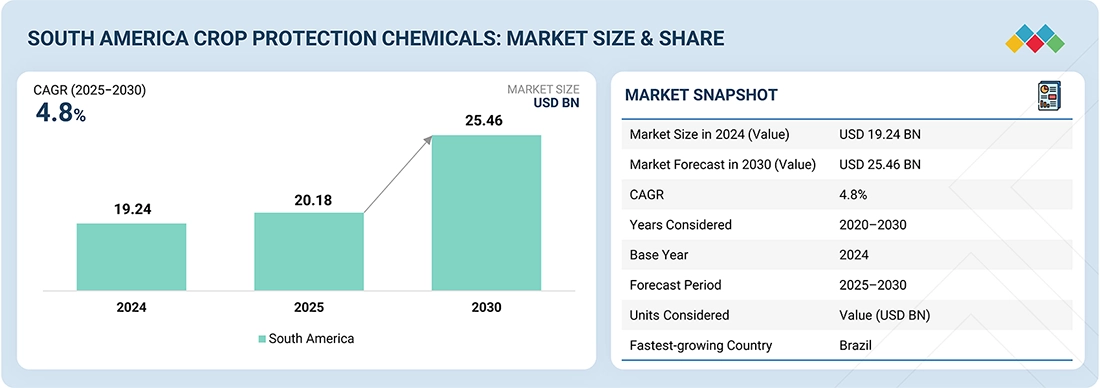
According to MarketsandMarkets™, The South America crop protection chemicals market is projected to grow from USD 20.18 billion in 2025 to USD 25.46 billion by 2030, registering a compound annual growth rate (CAGR) of 4.8% during the forecast period. Market expansion is primarily supported by large-scale commercial farming practices and extensive cultivation of major crops such as soybeans, corn, wheat, and sugarcane across the region.
Rising pressure from weeds, pests, and crop diseases—intensified by climate variability and growing resistance to existing solutions—is fueling demand for herbicides, insecticides, and fungicides. In response, farmers and agribusinesses are increasingly adopting integrated pest management (IPM), precision agriculture technologies, and complementary biological solutions to protect yields and enhance sustainability.
Market Growth Supported by Innovation and Precision Agriculture
The South America crop protection chemicals market is witnessing steady growth as producers focus on safeguarding productivity across vast agricultural landscapes. Continued innovation in crop protection formulations, alongside the rising adoption of seed treatments, precision spraying, and resistance management strategies, is strengthening market momentum. The integration of chemical and biological solutions is also emerging as a key trend, supporting more sustainable and effective crop protection programs.
Download PDF Brochure: https://www.marketsandmarkets.com/pdfdownloadNew.asp?id=62907941
Insecticides Lead the Market by Type
By type, the market is segmented into herbicides, insecticides, fungicides, and bactericides. Insecticides account for the largest market share, driven by widespread row crop cultivation and increasing insect pressure linked to climate change and intensive farming practices. Fungicides and bactericides play a critical role in preventing disease-related crop losses, particularly in cereals, fruits, and vegetables. Ongoing emphasis on resistance management and advanced formulation technologies continues to shape demand across all product categories.
Foliar Application Dominates by Mode of Application
Based on mode of application, the market is segmented into seed treatment, soil treatment, and foliar application. Foliar application remains the dominant method due to its flexibility and effectiveness in managing in-season weed, pest, and disease outbreaks. Seed treatment is gaining traction for its ability to provide early-stage crop protection, improve establishment, and reduce reliance on repeated foliar sprays. Soil treatment is widely used for controlling soil-borne pests and diseases, especially in high-value crops, with advancements in precision application tools enhancing overall efficacy.
Brazil Emerges as the Fastest-Growing Market
Brazil is expected to be the fastest-growing country in the South America crop protection chemicals market during the forecast period. Growth is underpinned by expanding production of soybeans, corn, sugarcane, and other staple and high-value crops. Increasing adoption of precision agriculture, integrated pest management practices, and a balanced mix of chemical and biological solutions is positioning Brazil as a key growth engine in the regional market.
Request Sample Pages: https://www.marketsandmarkets.com/requestsampleNew.asp?id=62907941
Leading South America Crop Protection Chemicals Companies:
Major companies operating in the South America crop protection chemicals market include Bayer AG (Germany), BASF SE (Germany), Corteva Agriscience (US), Syngenta Group (Switzerland), FMC Corporation (US), UPL Limited (India), ADAMA Agricultural Solutions Ltd. (Israel), Nufarm Limited (Australia), Sumitomo Chemical Co., Ltd. (Japan), Rotam CropSciences (Hong Kong), Bioceres Crop Solutions (Argentina), Ourofino Agrociência (Brazil), Nortox S.A. (Chile), Koppert Biological Systems (Netherlands), and Certis Biologicals (US).

No comments:
Post a Comment